
Haskell County Release Date Terms
Oklahoma records use several dates for different stages. A court sentence date starts the legal term. It is not a forecast. `PE DATE` in a Pardon and Parole Board result means parole eligibility date, the point at which consideration may occur. `PRD` means projected release date. A sentence-level `Discharged Date` in an ODOC profile records a completed event for that row.
ODOC calls its inmate-specific working date tentative because the calculation can move. The agency says inmates receive their days remaining each month and can calculate the date or ask a facility records officer or case manager. Ordinary public requesters generally cannot obtain that tentative date unless they fit an official need category identified by ODOC. A PPB result PDF can expose a PRD for a person on that particular docket, but many people will not appear there.
| Field | Meaning | What it does not prove |
|---|---|---|
| Sentence date or term | Legal starting input | The day physical custody ends |
| PE DATE | Parole eligibility | Parole approval or release |
| PRD | Projected release date | Completed discharge |
| Discharged Date | Recorded discharge for one sentence row | That all other sentences or holds ended |
Find Haskell County Projected Release
The right path depends on custody. A person awaiting trial at the Haskell County Criminal Justice Center usually has no computed prison release date. Bond, dismissal, a plea or sentence, a detainer, and court scheduling can all control the next event. For a county sentence, the court judgment, jail's credited-time calculation, and jail release entry are the proper records.
A person serving an Oklahoma prison sentence is different. Begin at the ODOC Offender Information gateway, then follow the public lookup. The search can preserve state records after release, yet its current data-source warning and abbreviated fields require care.
- Identify county-jail or ODOC custody before looking for a date. Do not apply prison-credit rules to a local jail sentence.
- For ODOC, search by DOC number. If unavailable, use the exact name and date of birth, then validate the photo, physical details, and court case.
- Read status, current facility, and every sentence row. A discharged row can coexist with another active sentence.
- Search the PPB Dockets and Results archive by month, DOC number, name, Haskell County, or case number when parole was considered.
- For Haskell County jail time, ask the court and jail for the judgment, credited-time calculation, and existing release entry.
- Confirm an actual event later through ODOC status, VINE, the facility, or the agency's discharge documentation.
The broader Haskell County released inmate lookup explains how to trace county, state, and federal custody after a roster changes. It is useful when the system holding the person is not yet clear.
Note: A person released from the county jail on bond may still have an open case, while a prison discharge is tied to sentence administration.
Haskell County Tentative Date Limits
Oklahoma's public system has a notable split. The ordinary ODOC offender detail has no verified public field for an individual tentative release date. ODOC's own FAQ says that date is confidential to general public requesters and can change. By contrast, PPB result sheets may publicly show `PE DATE`, `PRD`, and `BOARD ACTION` for the cases listed on that month's document.
These sources answer different questions. The ODOC profile can show `INACTIVE`, `OUTSIDE`, and sentence-level discharge dates. A PPB sheet shows the parole process at a given stage. A board grant or favorable recommendation may still be followed by administrative steps, conditions, another hold, or later custody evidence. An actual gate exit needs a later source.
The ODOC FAQ about tentative dates and offender records appears in the captured official page below.
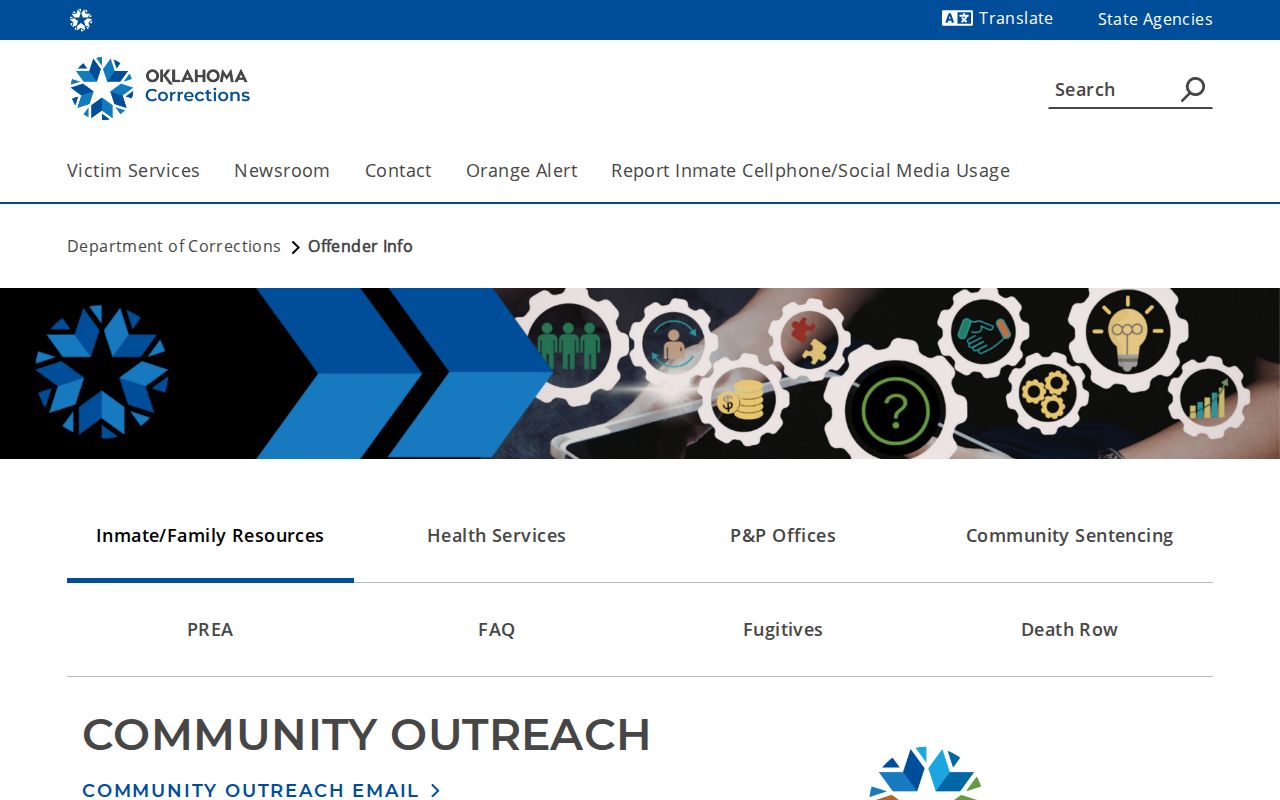
The official explanation supports cautious wording: a tentative date is a changing internal calculation, not a public promise that release will occur then.
Haskell County Earned Release Credits
For an ODOC sentence, 57 O.S. §138 establishes monthly earned credits by classification level. One earned credit equals one day. Classification reflects conduct, assignment, hygiene, time at level, and performance. Credits may be removed after required process and restored under ODOC policy. Life sentences do not receive ordinary earned-credit deductions.
The statute's cited schedule for people ever convicted or adjudicated of offenses listed in subsection E is zero, 22, 33, and 44 monthly credits at levels one through four. The schedule for others is zero, 22, 45, and 60. Section 138.1 also permits up to 100 credits for an approved meritorious act in the public interest and places limits on revoking those specific credits.
These numbers are inputs, not a safe home calculation. The correct release forecast also depends on classification changes, misconduct, sentence structure, accepted jail credit, achievement credits, and statutory floors. Multiple concurrent or consecutive sentences add more complexity. Only the official sentence audit can apply all of those parts to one Haskell County case.
Note: Earned credits can reduce time under Oklahoma law, but no published schedule alone proves a particular Haskell County release day.
Haskell County Eighty-Five Percent Rule
21 O.S. §13.1 lists serious offenses for which a person must serve at least 85 percent before parole consideration. Credits cannot reduce imprisonment below that statutory floor. The rule also reaches specified attempts, conspiracies, and solicitations.
It does not mean every Oklahoma prisoner serves exactly 85 percent. Nor does reaching the floor guarantee parole. Eligibility is also governed by 57 O.S. §332.7 and sentence-specific law. Life without parole and death sentences are ineligible. Aging parole under 57 O.S. §332.21 is a separate route with age, time-served, and offense exclusions.
The conviction date and offense matter. The PPB FAQ states that a parole investigator calculates eligibility from the court sentence after accepted jail credit and applies the law that governs the case. A public reader should avoid estimating from the charge name alone because amendments, multiple counts, and sentence structure may change the result.
Haskell County Release Date Changes
A projected date can move for reasons found in several official records. Some affect the sentence math. Others prevent a community release even when one custody term is ending. The exact effect belongs to the agency maintaining the sentence audit.
| Factor | Possible effect | Best confirming source |
|---|---|---|
| Earned-credit level or achievement | Changes credits applied to the sentence | ODOC records officer or sentence audit |
| Misconduct | Can remove credits or affect parole timing | ODOC disciplinary and sentence records |
| Jail-credit correction | Changes time credited before ODOC reception | Court order and ODOC audit |
| Appeal or post-conviction order | May alter a conviction or sentence | Haskell County court docket and official file |
| Commutation or parole action | Can change the legal path or expected date | PPB result, executive action, then ODOC |
| Detainer or other sentence | May cause transfer instead of community release | Holding and receiving agencies |
A transfer is not a release to the community. If the Haskell County jail turns someone over to ODOC, another county, federal authorities, or immigration officers, the first custody ended while another began. The receiving agency's status must be checked before interpreting a roster disappearance.
Haskell County Jail Release Math
County-jail sentences require their own record trail. No Haskell County jail good-time policy or weekend-release rule was found in the research. The ODOC prison-credit schedule should not be imported into a county sentence without legal authority. Ask the Haskell County Criminal Justice Center and court for the calculation actually used.
A narrow request can identify the person by full name, date of birth if known, booking date, and case number. Ask for the judgment, credited-time calculation if kept, and jail-register entry showing the date or manner of discharge. Under 51 O.S. §24A.8, the sheriff must make specified jail-register information available if it is kept, but the agency does not have to create a new forecast or custom list.
Do not assume a Friday exit when a term appears to end on a weekend. Bond action, a new court order, another warrant, transport, or local processing may control the event. The Haskell County jail at 1304 Industrial Road in Stigler can be reached at 918-967-2400 for current records routing.
Confirm Haskell County Actual Release
Confirmation comes after the forecast. For an ODOC person, check the public profile for status and every sentence's discharged date. If the result is unclear, ODOC Legal Services maintains an open-record channel, and the agency lists osordischarges@doc.ok.gov specifically for discharge questions. Existing public material can be requested without assuming closed records will be released.
For a pending custody change, OK VINE can provide a release or transfer alert from a participating county-jail or ODOC feed. Its event must be read with the reporting agency. A transfer, escape, or death alert is not a community release. The Haskell County VINELink inmate search explains the exact-match and notification path.
A public ODOC result should be read as a set, not as one label. Match the DOC number, birth date, photograph, and Haskell County case first. Then compare `Status INACTIVE`, `Current Facility OUTSIDE`, reception history, and each sentence row. The strongest public sign of a state discharge is an identity-validated profile where every applicable row has a discharged date. If one row remains active, or if a detainer appears elsewhere, do not turn the forecast into a claim of freedom from all custody.
County evidence has a different shape. A court order may authorize bond, dismissal, or completion, yet the jail register supplies the physical-event record. Ask whether the recorded event was community release or transfer and whether a receiving agency is named. That distinction resolves many apparent conflicts between the court date, a VINE alert, and the day a name leaves the Haskell County roster.
Finally, preserve the date, wording, reporting agency, case or DOC number, and access date. A saved PRD proves only what the forecast said at that time. A later discharge entry, jail register, or agency response provides the stronger historical record of what actually occurred.
Note: Preserve both the forecast and later discharge proof so a changed Haskell County release date can be explained accurately.